Dare To Ask RE
 Updated
What is Dare To Ask RE?
Dare to Ask® from Wendy Harrison is an enquiry-led framework for RE available to schools and Multi-Academy Trusts, launched in September 2026. It is not a scheme of work and does not replace existing syllabuses or faith-based curricula. Rather, it supports teachers in shaping thoughtful, enquiring RE within the context of their school or Trust. It does this by providing a structured approach to philosophical enquiry through carefully framed questions, and content inputs that support depth, accuracy, and reflection. Teachers retain responsibility for lesson-level planning and classroom activity. Dare to Ask® focuses on the way pupils think, question, reflect, and engage with religion and worldviews.
Find more detailed guidance on the Dare To Ask framework here.
RE Assessment Framework
RE presents a particular challenge for assessment because schools work with a wide variety of locally agreed syllabuses, curricula and schemes of work. Wendy identified that there was a need for an accessible framework that was not tied to a particular published curriculum or scheme. She went on to develop a set of RE progression statements for Years 1–6 to support the assessment of RE, irrespective of what RE scheme of work you may be using in school.
The Dare To Ask RE objectives assessment framework is free to use in Insight for all Insight subscribers.
This framework draws upon Wendy's work on the Leicester and Lincolnshire syllabuses and is based around key concepts in Religion and Worldviews and is designed to be flexible enough to work alongside different curricula and schemes of work.
The framework includes progression statements setting out key learning, together with guidance to support teachers in making judgements about pupils’ understanding. There are also examples of summative assessment tasks for each year group, linked to the judgement statements.
The Four Concepts
The assessment framework is built around four concepts:
- Beliefs
- Community
- Expression
- Sacred
When thinking about assessment teachers should first decide which concept(s) they will focus upon. Many RE topics will touch on all four concepts. For example, learning about a celebration or festival might include:
- Beliefs: what does a celebration tell us about beliefs?
- Community: how does a festival bring people together?
- Expression: what actions and symbols are associated with the celebration?
- Sacred: what aspects of a festival make it sacred?
It is for teachers to decide whether to assess all areas or have a tighter focus on one or two.
Progression statements: formative assessment
These are linked to the four concepts and set out what teachers expect pupils to learn, i.e. the learning goals or objectives. Teachers are not expected to make use of all the progression statements but should focus upon the ones which provide the best information about pupils’ learning.
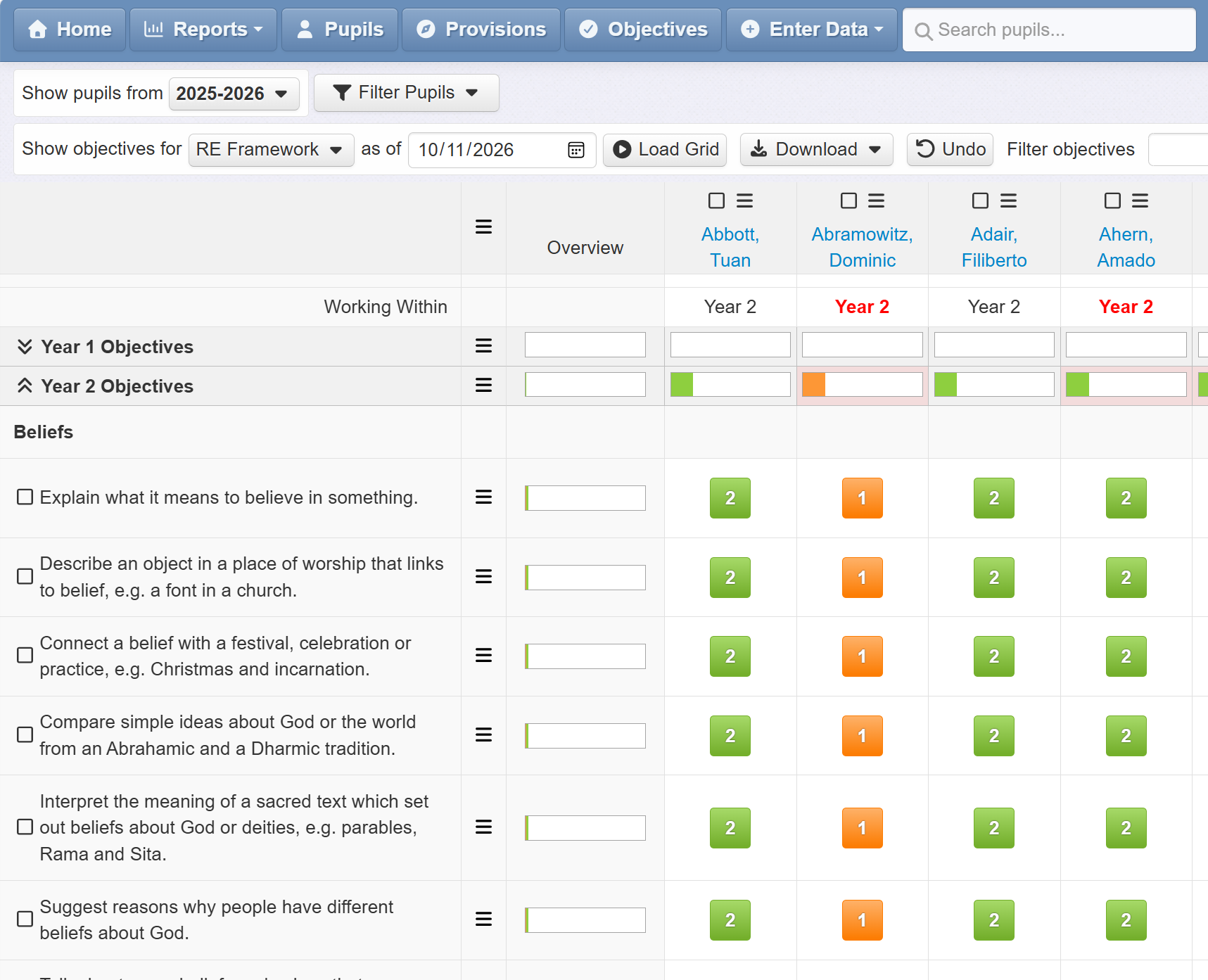
How To Add the Dare To Ask RE Objectives to your Insight Account
Insight users with Admin permissions can add the Dare To Ask RE Objectives to your account instantly. This Help Guide will walk you through the process.
